
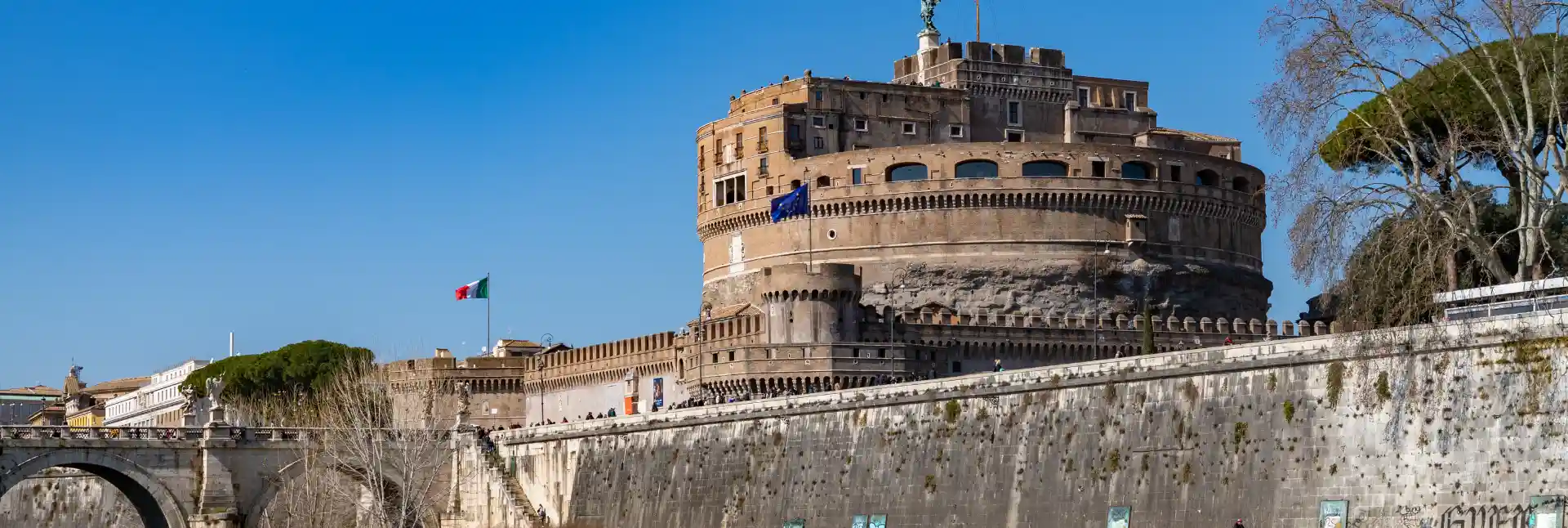
Castel Sant’Angelo and the Vatican: a key relationship in the history of Rome
When we talk about the history of this monument, one of the most striking chapters is its connection with Rome’s religious, political, and military power. Its proximity to the Vatican is no coincidence, and its history is closely linked to that of the popes and the most critical moments in the history of the Church. Would you like to learn about the conspiracies, sieges, and escapes in which Castel Sant’Angelo played a leading role?
Castel Sant’Angelo: from imperial mausoleum to papal fortress
During the Middle Ages, the mausoleum was incorporated into the walls of Rome and began to take on a military character. It was at this time that the popes recognized its enormous strategic value. Its location, relatively close to St. Peter’s Basilica, made it an ideal refuge in case of danger. Thus began a relationship that would never be broken: Castel Sant’Angelo became a defensive extension of the Vatican.
This bond was strengthened especially from the 14th century onward, when the popes definitively returned to Rome after the Avignon period (from 1309 to 1377, the popes resided in this French city instead of Rome).
From that moment on, the castle became a true papal fortress, with private apartments, audience halls, weapons storerooms, and even prisons.
The Vatican and the need for protection
To understand the importance of Castel Sant’Angelo in relation to the Vatican, it is necessary to place it within the context of medieval and Renaissance Rome. The popes were spiritual leaders, but also temporal rulers of the Papal States. This made them political figures exposed to internal conflicts, foreign invasions, and constant power struggles.
The Vatican, as we know it today, was not always fortified. For centuries, St. Peter’s Basilica and the Apostolic Palace were relatively vulnerable spaces. For this reason, having a secure refuge just minutes away was an absolute priority. Castel Sant’Angelo fulfilled this role perfectly: solid, easy to defend, and directly connected to St. Peter’s Basilica—but how?
The Passetto di Borgo: the secret passage between the Vatican and Sant’Angelo
This connection is provided by one of the most fascinating elements of the monument: the Passetto di Borgo. It is an elevated, fortified passageway about 800 meters long that connects the Vatican with Castel Sant’Angelo, running along the top of the Leonine Walls.
The Passetto was built in 1277 by order of Pope Nicholas III. Its purpose was to provide a safe escape route for the pontiff in case of danger. It was not a symbolic or decorative structure, but a piece of military infrastructure designed for extreme situations. From the Vatican, the pope could access the corridor and reach the castle without being seen from the outside.
This elevated passage integrated perfectly into the city’s defensive system and allowed for fast, protected movement, even during a siege. Its very existence reveals the extent to which papal power felt threatened in certain periods.
Was the Passetto di Borgo ever used?
Yes, and one of the most famous episodes took place in 1527, during the Sack of Rome. In this dramatic context, the imperial troops of Charles V—largely composed of mercenaries—stormed the city, causing unprecedented devastation.
Pope Clement VII was in the Vatican when the attack began. Faced with the seriousness of the situation, he used the Passetto di Borgo to flee to Castel Sant’Angelo, accompanied by a small group of cardinals and guards. While the city was being looted, the castle withstood the siege for weeks, becoming the pope’s refuge.
This episode demonstrated the role of Castel Sant’Angelo as a safeguard of papal power. It was not just another fortress, but an essential element in the institutional survival of the papacy.
Enjoy Castel Sant’Angelo and the Vatican today
Today, Castel Sant’Angelo is one of the most comprehensive museums in Rome. From its terraces, visitors can enjoy privileged views of the Vatican and the Tiber River—an ideal perspective for understanding its strategic location. The visit becomes even more meaningful when it is placed within the context of its historical relationship with the papacy and the Passetto di Borgo.
Would you like to imagine what Clement VII felt while hiding in Castel Sant’Angelo? We recommend discovering this monument with expert guidance, as many of its details go unnoticed without proper context. If you are planning your trip and want to delve deeper into this fascinating history, purchasing tickets for Castel Sant’Angelo in advance is an excellent decision to avoid queues and secure access. And if you combine it with a visit to the Vatican, you’ll enjoy the complete experience!