
10 little-known facts about Castel Sant’Angelo
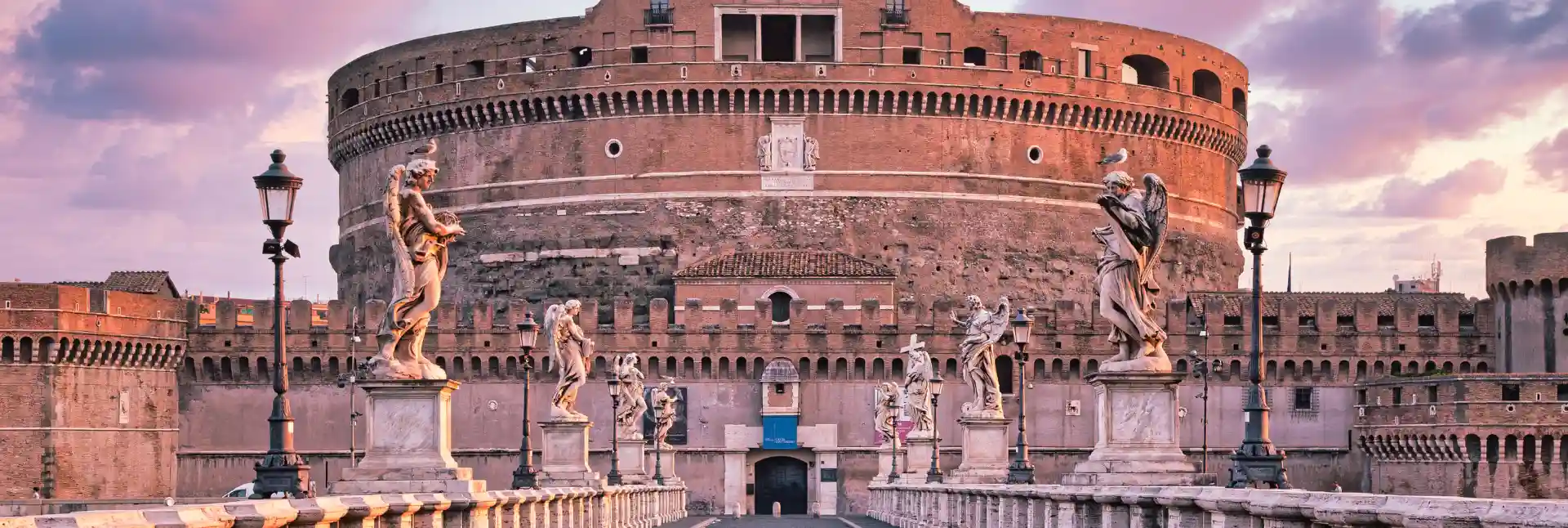
Rome is made up of overlapping layers of history, monuments that have reinvented themselves over the centuries, and places that hide surprising secrets. Among them all, Castel Sant’Angelo, on the banks of the Tiber River, is an imposing stronghold that stands out not only for its unmistakable silhouette, but also for the many stories, legends, and lesser-known episodes hidden behind its walls. Today, we share some fascinating facts about Castel Sant’Angelo.
Top facts about Castel Sant’Angelo
1. It was originally built as a mausoleum
One of the greatest surprises about Castel Sant’Angelo is that it was not originally conceived as a fortress or a papal residence. In the 2nd century AD, Emperor Hadrian ordered its construction as a mausoleum for himself and his family. At that time, it was known as the Mausoleum of Hadrian, and its appearance was very different from what we see today.
The building was clad in marble, decorated with statues, and crowned by a large landscaped mound. Nothing suggested the transformation it would undergo centuries later, and this remarkable ability to adapt is one of the keys to its historical importance.
2. The angel on top was born from a vision
The castle’s current name is linked to a legend deeply rooted in Roman tradition. In the year 590, a devastating plague struck the city. According to tradition, Pope Gregory the Great saw the Archangel Michael sheathing his sword above the ancient mausoleum, interpreting this gesture as the end of the epidemic.
From then on, the building became known as Castel Sant’Angelo, and a sculpture of the angel was placed at its summit. The statue seen today is made of bronze and dates from the 18th century, but it commemorates a vision that marked Rome’s spiritual history. In fact, the epidemic ended shortly afterwards.
3. A prison as feared as it was chilling
Over the centuries, the castle also served a far darker purpose: that of a prison. Behind its thick walls, prisoners of all kinds were confined, from political opponents to prominent historical figures.
The cells varied depending on the prisoner’s status, but some were true punishment spaces, with barely any light and almost no freedom of movement. Even today, walking through these rooms sends a shiver down the spine when imagining life within these walls. Without a doubt, this is one of the most striking facts about Castel Sant’Angelo for visitors.
4. An escape that defied the impossible
Although escaping from these cells seemed like an impossible mission, history tells us that at least one person managed to do so. The famous sculptor Benvenuto Cellini was imprisoned here in the 16th century, but miraculously managed to escape by descending the walls using improvised ropes.
He was captured again shortly after his escape, but his story became one of the castle’s most legendary tales, further reinforcing the aura that surrounds the monument.
5. A secret passage to save the popes’ lives
One of the castle’s most fascinating structures is the Passetto di Borgo, an elevated and fortified corridor that connects the Vatican with Castel Sant’Angelo. This passageway was used as an escape route by several popes during moments of grave danger.
The most famous case is that of Pope Clement VII, who used it during the Sack of Rome in 1527. This corridor symbolizes the close relationship between the castle and papal power, as well as its strategic role in the defense of the city.
6. The castle also left its mark on opera
One of the curiosities of Castel Sant’Angelo is that it plays a prominent role in the history of opera. In the famous work Tosca by Giacomo Puccini, the castle is the setting for the tragic finale.
This connection with music and the performing arts shows how the monument has gone beyond its architectural function to become an internationally recognized cultural symbol—and not only in ancient times.
7. A key setting in “Angels & Demons”
Fans of contemporary cinema and literature will recognize the castle from its appearance in Angels & Demons, based on the novel by Dan Brown. In the film, Castel Sant’Angelo is portrayed as a place filled with mystery, conspiracies, and hidden secrets. We won’t reveal its role in the movie here, but we highly recommend watching it—and this is not the only field in which the monument takes center stage.
8. Also present in the world of video games
The castle has also conquered the digital world thanks to the famous video game saga Assassin’s Creed. It appears recreated with great historical and architectural accuracy, becoming one of the most recognizable settings in the game.
In this context, the castle is not just a backdrop, but a key space within the narrative, associated with power, surveillance, and conspiracies that define the storyline. For many players, it was their first contact with this Roman monument, sparking curiosity about its real history and importance within the city.
9. “Mastro Titta crosses the bridge”
One of the most disturbing facts about Castel Sant’Angelo is that, for centuries, the Sant’Angelo Bridge was the stage for a ritual both feared and well known by Romans. “Mastro Titta,” the papal executioner, would cross the bridge to carry out public executions. His passage was an unmistakable sign that someone was going to die that day.
This phrase became etched in the city’s collective memory and represents one of the darkest sides of Roman history.
10. Sant’Angelo Bridge: much more than an access point
And speaking of the bridge, we cannot talk about the castle without mentioning Sant’Angelo Bridge, also built during Hadrian’s time. Originally designed to connect the city with the mausoleum, it is now one of the most beautiful bridges in Rome.
Its angels, created within Bernini’s artistic circle, represent instruments of the Passion of Christ and turn the walk toward the castle into a unique symbolic and aesthetic experience. Observing each sculpture closely is a way to understand how art, religion, and history dialogue in Rome.
Do you want to experience these curiosities of Castel Sant’Angelo?
To fully enjoy all these stories and spaces, we recommend planning your visit carefully. Purchasing tickets for Castel Sant’Angelo in advance will allow you to avoid queues and focus on what truly matters: living the experience.
If you also want a detailed, contextualized explanation tailored to your interests, we can accompany you so that you discover every corner from a new perspective. You can buy tickets for Castel Sant’Angelo with a guided tour, where we will share these and many other fascinating facts about the castle.